
Traditional Forms and Free Verse
James Lewis Huss’s poems, both traditional and free verse, have appeared in numerous literary journals, magazines, and anthologies, including Argus, Lit Shark Magazine, Torrid Literature Journal, Inkhorn Review, slips slips, Top-Shelf Literary, and elsewhere. James’s full-length poetic works include an epic in blank verse, three poetry collections, and a verse novel.
Poetry Books and Collections
Out of the Water: The Epic of Moses
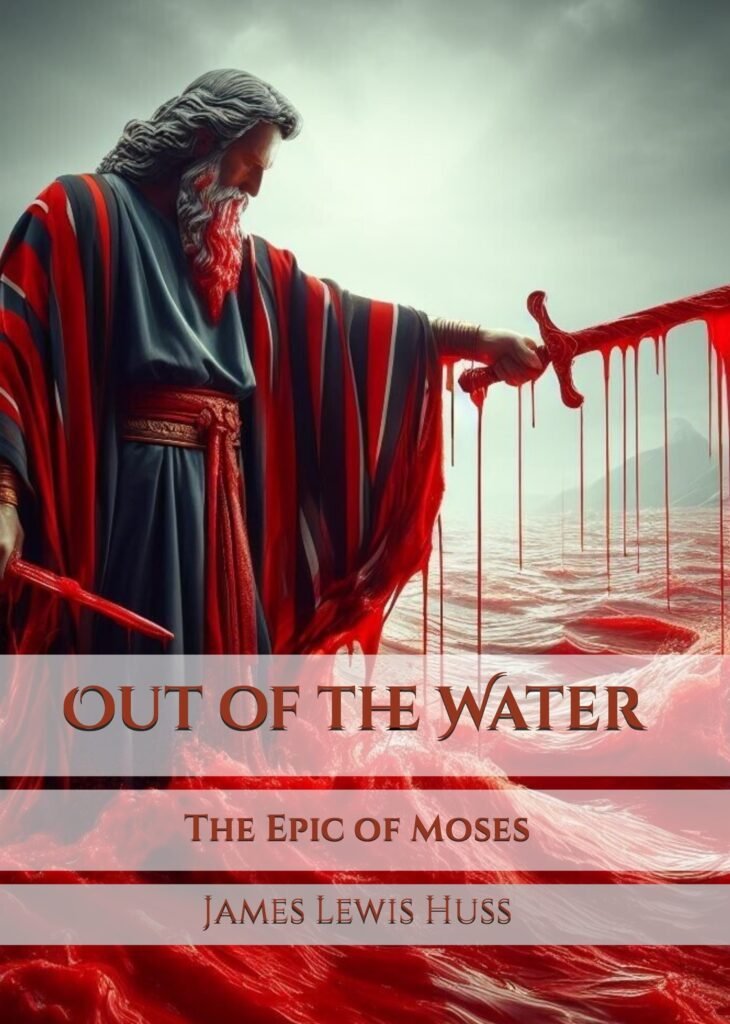
Out of the Water is a satirical epic in blank verse, the epic of the prophet-king Moses. The story remains true to the tales of of the Hebrew tribe as told in the Old Testament. Except in this epic Moses does not obey the word of God. Instead he follows his bicameral voice, his own mind projected as a hallucination heard from a fiery bush or a grumbling volcano. And just like the Old Testament, Out of the Water is a narrative of war and murder, of faith and devotion, of conquest and failure, a narrative of the legendary journey of the Hebrew people as they wandered the desert in search of the land their god promised to their epic hero, he who from the waters came—Moses.
A Thousand Thousand Petty Phrases
Perhaps there is no other poetic form in the English language that carries with it the mystique and allure of the sonnet. Revived in the 14th century by the Italian poet Petrarch, the sonnet was popularized in English by Renaissance writers like William Shakespeare and Edmund Spenser. The sonnet, with its strict meter, rhyme scheme, and thematic structure, is a challenging but rewarding form, which is probably why it continues to appeal to poets centuries after its revival.
bliss is a fitter muse than misery
Robert Frost famously quipped that writing free verse poetry is like playing tennis “without a net.” And yet free verse poetry can be just as challenging as the classical forms. bliss is a fitter muse than misery is not just poetry without form, but a free expression of the elements of sound that make words and phrases into poetry.
Other Published Poetry
Argus: Fallen Rain (2015): “My Privy Universe” (2nd place)
The Society of Classical Poets (2015): “Heritage, not Hate,” “Life”
Argus: Masquerade (2016): “Art,” “Meditations on Poetry”†, “One Day,” “Life”
Argus: Constellations (2017): “Never,” “Dating Profile,” “Meditations,” “Langston Hughes and White Man’s Blues”†
Torrid Literature Journal Vol. XXI: Rediscovering the Passion II (2018): “It Sits”
Argus: Madrugada (2019): “Next to Me,” “Nothing,” “A Thousand Deaths,” “Sunrise,” “Awaiting,” “This Is What Love Is Like”
Torrid Literature Journal Vol. XXV: Synergy (2020): “My Pen, Your Pen”
Wingless Dreamer: The Wanderlust Within (2021): “Asia”
Heartfelt Poetry Collection (2021): “Words and Phrases” (top finalist)
Wingless Dreamer: Bravehearted Goliaths (2026) “I’m Not That Kind of Teacher”†
Lit Shark Magazine, Issue 11 (2026): The SHARK DOG Edition: “great-granny’s quilt”†, “Fahrenheit 68”†, “Dad Bod”†
Haikuist (2026): “One Day” (abridged)
Aura Literary Arts Review (2026): “Textbooks”††
Inkhorn Review: Autumn 2026: “How Now Brown Cow”†
slips slips, “Distractions” (2026): “Instapoem”†
Top-Shelf Literary (2026): “Dough!”† (online, “Off the Page”); “nontoxic masculinity”† (anthology Lamps in the Dark)
Tap Into Poetry Edition 35 (2026): “prose vs. poetry”†
Wordpiece Winter/Spring 2027: “we are still afraid”†
† fromThis is America.
†† from Dreaming Isn’t Easy
Coming Soon
This Is America.
This Is America. is a collection of free range and traditional poems that cover a broad range of topics related to the American dream, which is not exactly the American reality. And therein lies the conflict of the work and of my life. Topics in the collection include white privilege (I’m a white guy), racism (I’m anti-racist), immigration (my wife is an immigrant), Confederate “heritage” (I grew up in the South), fatherhood (I have two boys), politics (I oppose fascism), class and poverty (I’m a teacher, so I’m broke), and other things on the minds of me and my fellow Americans.
Dreaming Isn’t Easy, A 90% True Story about a Regular Kid Growing up in the South.
Dreaming Isn’t Easy is a verse memoir set in late 80s/early 90s Laurens, South Carolina. The narrator is a teenage boy named Jacob who lives in a oppressively religious household with a father whose notion of discipline involves a leather belt and routine “attitude adjustments.” Jacob struggles to understand what it means to be an adult—especially a man in the South—amidst conflicting ideas from the religion he learned at home, the science he’s learning at school, and the philosophy he’s learning through karate. And of course there are issues of racism that haunt his Southern town and his adolescent experience. In the end he escapes the racism and the fundamentalism virtually unscathed, with a new black belt and philosophy to boot, and sets off for his journey to college and life.